Sustainable Development of Geographical Environment

Sustainable Development of Geographical Environment

Guide for Authors

Authors’ Guidelines

Guidelines for Manuscript Preparation and Article Acceptance Requirements of the Quarterly Journal of Sustainable Development of Geographical Environment

The regular and effective publication of scientific research in any specialized quarterly journal requires adherence to precise content and formatting frameworks that ensure the journal’s academic quality. The scientific journal Sustainable Development of Geographical Environment publishes scientific findings in the fields of geographical sciences (physical and human geography) and related sustainable development studies. The journal is published in Persian in four issues per year, and the abstracts of the articles are also provided in English.

A list of the journal’s subject areas and its latest published issues is available on the journal’s website. Before submitting a manuscript, authors are required to verify that the subject of their article is consistent with the journal’s scope. As a recognized reference in the fields of geographical sciences and related interdisciplinary studies, the journal seeks to provide an appropriate platform for knowledge exchange and theoretical development by adhering to scientific research standards and enhancing the quality of academic output. Accordingly, manuscripts submitted to the journal must be prepared and submitted with full attention and in accordance with specified criteria so that the review, evaluation, and publication processes can be conducted in a transparent, consistent, and reliable manner. This checklist, as the “Authors’ Guidelines,” provides all the requirements for preparing, formatting, and submitting a manuscript in a step-by-step manner.

General Principles and Article Acceptance Requirements

  • The manuscript must be the result of original, scientific, and innovative research.
  • The manuscript must not have been previously published or simultaneously submitted to another journal.
  • The similarity rate of the manuscript must be less than 10%, and an official report from the Samim Noor system must be submitted.
  • The originality and distinction of the research in relation to previous studies must be explained in the abstract and at the end of the theoretical foundations section.
  • The journal reserves the right to reject, conditionally accept, or request revisions to a manuscript.
  • The corresponding author is responsible for the accuracy of the content, compliance with research ethics, and the authors’ details.
  • Submitted files will not be returned after the final decision.
  • Changing or rearranging the names of authors after acceptance is not permitted.
  • It should be noted that only manuscripts prepared and submitted in accordance with the Authors’ Guidelines and the journal’s Word format will be considered for review.

Peer-Review Process and Fee Policy

Following an initial review and verification of compliance with the formatting requirements, manuscripts are sent to reviewers through a double-anonymous peer-review process.

The review process includes:

  • Acceptance, rejection, or revision by two reviewers
  • In the event of disagreement, submission to a third reviewer

Fees (in accordance with the regulations of the Ministry of Science)

  • Two million Iranian rials for evaluation and peer review (first stage; non-refundable)
  • Four million Iranian rials for publication of an accepted article (after final acceptance)

Required Files for Manuscript Submission

Submission is carried out only through the journal’s online system and must include the following:

A. Authors’ Information File

  • Persian and English titles of the article
  • First and last names, academic department, faculty, university, city, and country (in Persian and English)
  • Institutional email address and ORCID iD of all authors
  • Complete details of the corresponding author: postal address, telephone number, and email address

B. Main Manuscript File (without Authors’ Names and in the Journal’s Standard Format)

  • Must not contain any author names or identifying information in the manuscript text or file properties
  • No Page Breaks
  • Tables and charts must be provided in editable format (not as images)
  • Single-column format

To obtain the Main Manuscript File and the Authors’ Information Form, click on the respective links.

C. Supplementary Files

  • Tables and charts: Word or Excel format
  • Images and maps: JPG or TIF format with a minimum resolution of 300 dpi
  • Each item must be uploaded separately.

D. Similarity-Detection File

  • Official Samim Noor report (less than 10%)

E. Research Ethics Files

Manuscript Structure and Length

Manuscript length: 6,000–7,000 words (maximum 8,000 words including all sections)

Components of the Manuscript

1. Title

  • Short, clear, and informative

2. Extended Abstract

The Persian and English extended abstracts should each be 500–600 words and consist of four paragraphs, covering the following:

  • Introduction
  • Materials and Methods
  • Results and Discussion
  • Conclusion

Before publication, the abstracts must be reviewed and approved by the journal’s English-language editor.

3. Keywords

  • 3 to 5 scientific keywords consistent with the article title

4. Introduction

  • Statement of the problem, significance, objectives, systematic literature review (theoretical foundations), research background, research gap, and originality/innovation

5. Materials and Methods

  • Study area
  • Research methodology: type of research, population and sample, instruments, and analytical method

6. Results and Discussion

  • Scientific presentation using standard tables and charts

7. Conclusion

  • Comparison with similar studies, interpretation of findings, applications, limitations, and recommendations

8. Acknowledgments (if applicable)

  • Acknowledgment of financial sponsors or organizations providing data
  • It is not customary for authors to thank one another.
  • Acknowledgments should be based on scientific collaborations and should be stated before the reference list.
  • If there has been no scientific or financial collaboration, the following statement by the authors is mandatory: “The authors of this article did not receive financial support from any organization or institution.”

9. Footnotes

  • Latin equivalents of terms should be provided at the bottom of the same page (footnotes).

Principles for Formatting Tables, Figures, and Equations

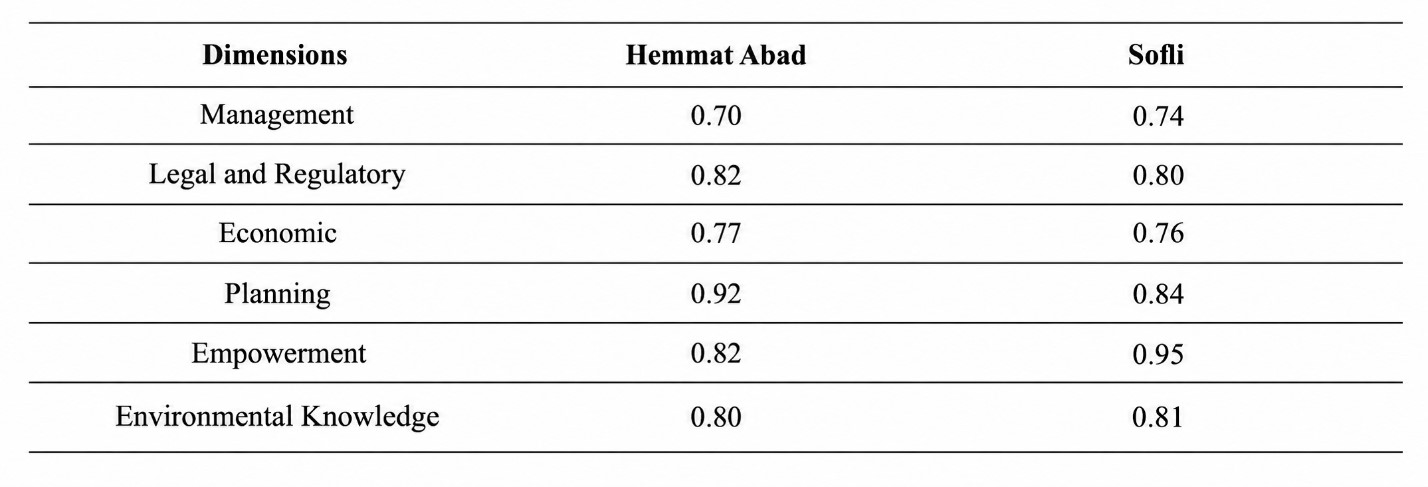
  • Tables should be presented without outer borders and with the title placed above the table.
  • The source of tables and figures should be written in bold after the title (as shown in the example).
  • Each table and figure must be explained in the text.
  • Images must be clear and include a scale.
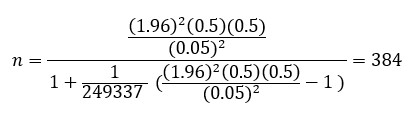
  • Equations must be numbered, and their symbols must be defined.
  • Persian decimal numbers should be written using “/”, while English decimal numbers should be written using “.”.

  Figure 1. The Developed Model with Significance Coefficients (T)
(Source: Hosseinpour et al., 2024 [1403])
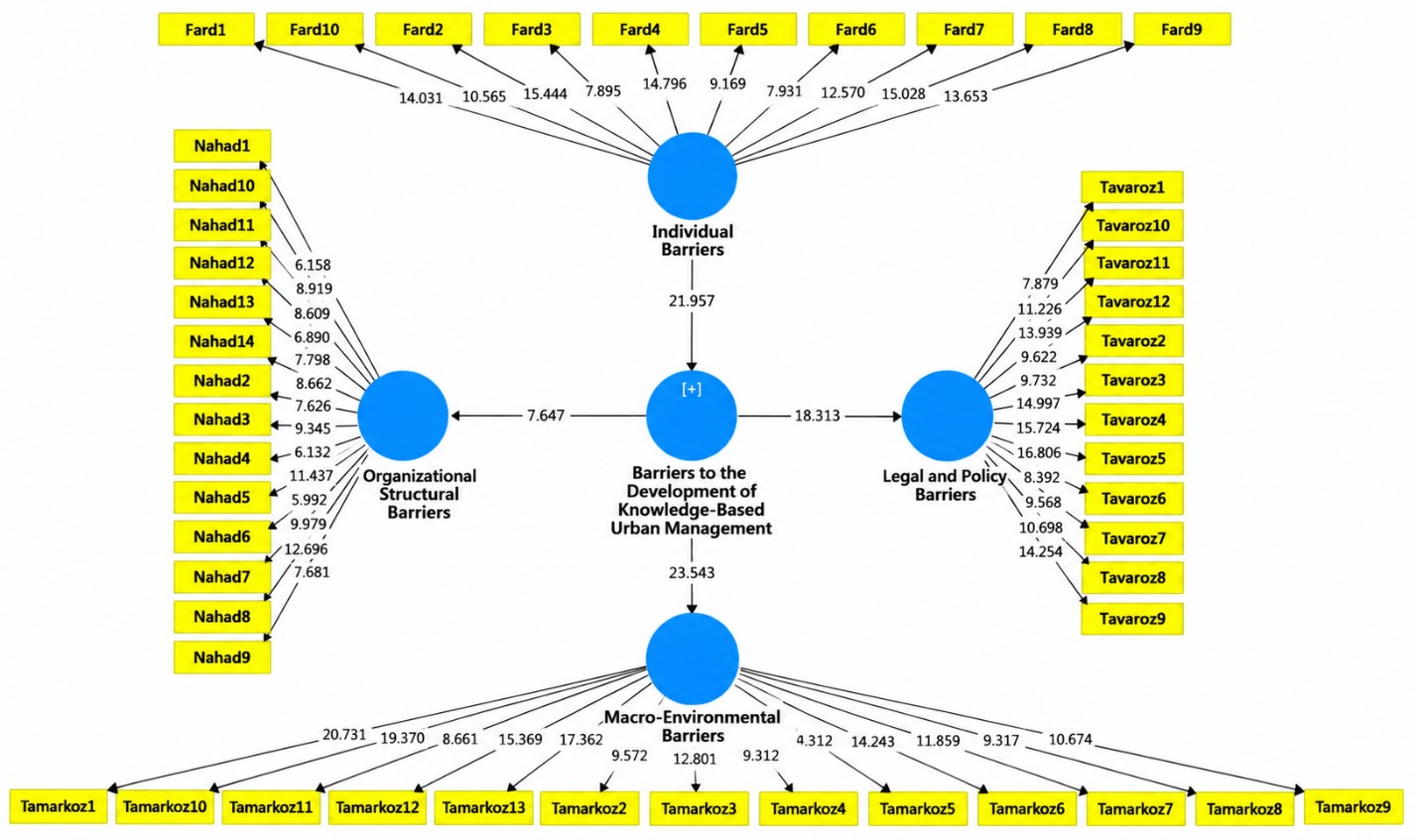
Table 1. Reliability of the Expert Questionnaire
(Source: Momeni et al., 2025 [1404])
Equation 1.
Typesetting and Page Layout Guidelines

  • A4 paper size should be selected.
  • Page margins should be set to 3.5 cm at the top, 2.5 cm at the bottom, and 3 cm on the left and right.
  • Line spacing should be set to Single.

Fonts

Section

Font

Size

Article Title

B Nazanin Bold

16

Authors’ Names

B Nazanin Regular

13

Section Headings

B Nazanin Bold

13

Subsection Headings

B Nazanin Bold

12

Persian Abstract

B Nazanin Regular

12

English Abstract

Times New Roman

11

Main Text

B Nazanin Regular

12

Figure/Chart Caption

B Nazanin Bold

10

Persian References

B Nazanin Regular

11

English References

Times New Roman

10

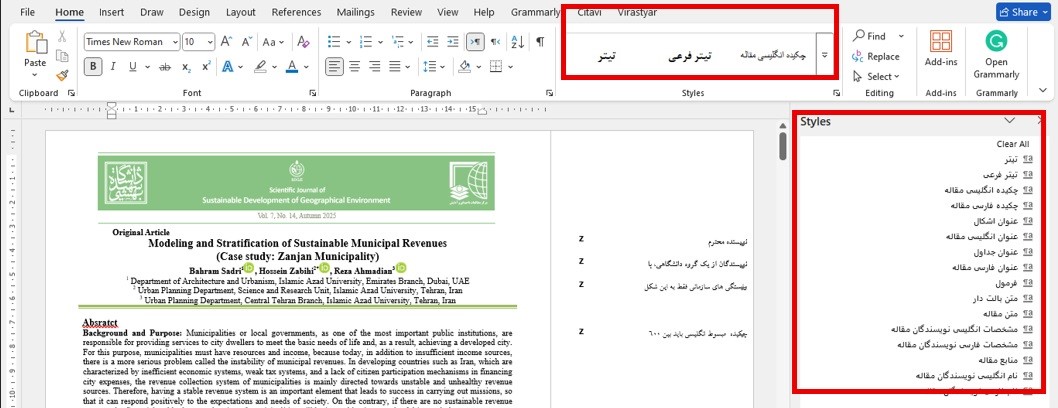
  • All required formatting styles have been prepared in the Style section and are readily available for authors to use.

Reference Formatting Style (APA Standard)

  • Reference list: References should be formatted according to APA 7th edition. All references cited in the text and included in the reference list should be written in English.
  • The publication year in the Gregorian calendar should be provided.
  • For one author: (Timperio, 2004)
  • For two authors: (Appleyard & Lintell, 1972)
  • For more than two authors: (Timperio et al., 2004)
  • When more than one source is cited simultaneously in the text, the references should be included within a single pair of parentheses and separated by a semicolon (;) in the following order, for example:
    • (Rezvani et al., 2019; Karimi & Ahmadi, 2021; Hosseini, 2023).
    • Note: Please pay careful attention to the punctuation marks used to separate references.
    • References and sources at the end of the article should be arranged alphabetically, using Times New Roman, 10 pt, and following APA citation style. Examples of reference formatting are provided below:

Book

Rahimi, M., & Karimi, A. (2020). Principles of sustainable geography. Tehran: University Press, 420 p.

Article

Akbari, A. (2022). Exploring the factors of the organizational structure of knowledge management in the libraries of medical universities. Health Information Management Journal, 18(6), 286–290. doi: 10.52547/jipm.37.1.59. [In Persian]

Haunschild, R., & Bornmann, L. (2022). Relevance of document types in the scores’ calculation of a specific field-normalized indicator: Are the scores strongly dependent on or nearly independent of the document type handling? Scientometrics, 127(8), 4419–4438. doi: 10.52547/jipm.37.1.59

Vakkari, P., Chang, Y. W., & Järvelin, K. (2022). Largest contribution to LIS by external disciplines as measured by the characteristics of research articles. Scientometrics, 127(8), 4499–4522. doi: 10.52547/jipm.37.1.59

Wheeler, J., Pham, N. M., Arlitsch, K., & Shanks, J. D. (2022). Impact factions: Assessing the citation impact of different types of open access repositories. Scientometrics, 127(8), 4977–5003. doi: 10.52547/jipm.37.1.59

  • If a Persian-language source is translated/transliterated into English, the phrase [In Persian] should be added at the end.
  • An active link should be provided as a hyperlink at the end of each reference.

It is essential that the unique identifier DOI or DOR, or both, be provided at the end of the references for each article.