Sustainable Development of Geographical Environment

Sustainable Development of Geographical Environment

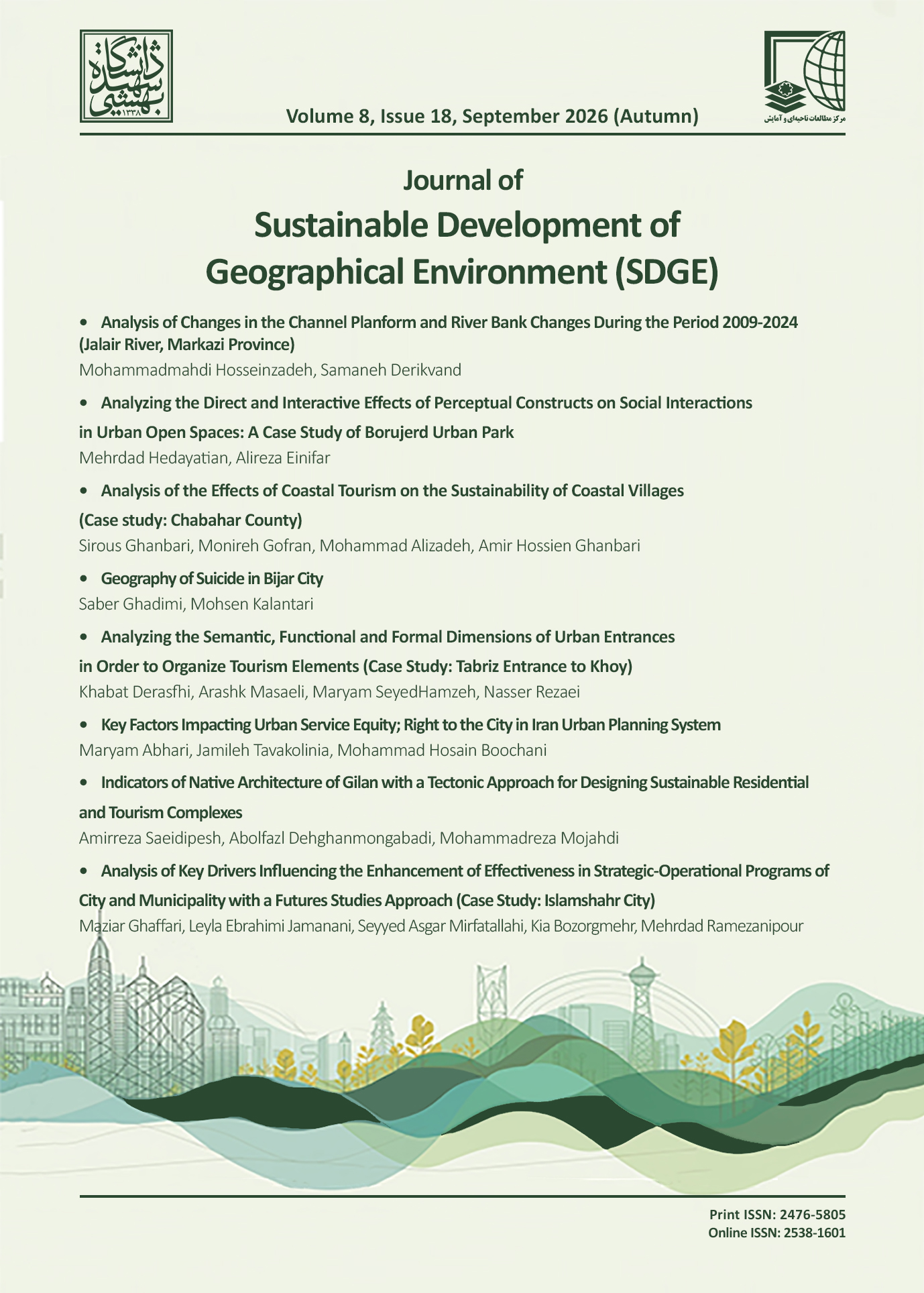
The Quarterly Journal of Sustainable Development of Geographical Environment is published with the aim of producing, disseminating, and enhancing the level of theoretical and empirical knowledge in geographical sciences. The journal was established in 2015 [1394 in the Iranian calendar] and, with the support of the Sustainable Development Research Pole, obtained its publication license from the Ministry of Culture and Islamic Guidance. Since 2021 [1400 in the Iranian calendar], with the support of the Center for Regional Studies and Spatial Planning at the Faculty of Earth Sciences, Shahid Beheshti University, it has been published as a scientific journal with a “A” ranking. The purpose of publishing this journal is to expand communication among researchers and to address the country’s research and policymaking needs, thereby contributing to the sustainable development of the geographical environment within the framework of emerging topics.

  • Before submitting an article, please read the Authors’ Guidelines in order to expedite the evaluation process. Articles that do not comply with the requirements specified in the guidelines will not enter the evaluation process.
  • All articles submitted to this quarterly journal will be checked, prior to entering the peer-review process, using the similarity-detection software Samim Noor. Therefore, authors are kindly requested to use the Samim Noor similarity-detection system or other similar systems before submitting their articles in order to expedite the evaluation process. The similarity rate of submitted articles must be less than 10%.
  • The peer-review process of articles in this journal is double-anonymous, meaning that the identities of the authors and reviewers are not disclosed to one another.
  • To obtain the prepared article template, please click on the following link: Article Template.
  • All authors are required to have an ORCID iD. To obtain an ORCID iD, please register through the following link: https://orcid.org/register.
  • The initial evaluation and peer-review fee is 2,000,000 Iranian rials, and the publication fee is 4,000,000 Iranian rials.
  • This journal is subject to the international Creative Commons Attribution License (CC BY).
  • After an article has been published, no changes to the authors’ details will be permitted under any circumstances.
  • The reference citation and formatting style follows the APA standard.


Current Issue: Volume 8, Issue 18, Summer 2026, Pages 1-148 (Autumn) 

Publication Information

Indexing and Abstracting

Keywords Cloud

  • Sustainable development
  • Sustainability
  • Environment
  • Sustainable Urban Development
  • Development
  • Housing
  • Tourism
  • Resilience
  • City
  • Spatial analysis
  • Tehran
  • Urban Development
  • Tabriz
  • Planning
  • Urban planning
  • Social interactions
  • Futures Studies
  • Crisis Management
  • Iran
  • Green space
  • Urban management
  • Karaj
  • urbanization
  • Grounded theory
  • Meta-analysis
  • content analysis
  • livability
  • AHP
  • Public spaces
  • right to the city
  • Satisfaction
  • Ardabil
  • social justice
  • urban livability
  • Inequality
  • Culture
  • participation
  • vulnerability
  • Strategic planning
  • Spatial Justice
  • Climate
  • Land use
  • Urban environmental quality
  • Sustainable Rural Development
  • Factor analysis
  • Tabriz Metropolis
  • Decentralization
  • Key drivers
  • Presence
  • Lorestan province
  • Energy
  • Rural settlements
  • Passive Defense
  • Islamic city
  • Structural Equations
  • Environmental sustainability
  • Urmia
  • Physical Factors
  • Strategy
  • Smart City
  • GIS
  • Maragheh City
  • Micmac
  • Quality of life
  • Rural areas
  • Good Governance
  • Geopolitics
  • Covid
  • Ilam
  • Ranking
  • Governance
  • Infrastructure
  • Citizen Satisfaction
  • Neighborhood
  • Zanjan City
  • Social Capital
  • strategic plan
  • Isfahan
  • migration
  • Green Building
  • Spatial quality
  • Women
  • Air pollution
  • Feasibility
  • Bijar city
  • Region 4
  • Agriculture
  • Environmental hazards
  • Smart Growth
  • urban resilience
  • sustainable income
  • Zanjan Municipality
  • Morphology
  • \"
  • Policymaking
  • Structural empowerment
  • Behavior
  • Urban tourism
  • Sustainable Tourism
  • Sustainable employment
  • public participation
  • Varamin City
  • Ecosystem instability
  • \' \' Supportive Action \'
  • Available resources
  • Outdoor thermal comfort
  • Cultural sign
  • Human Development Index
  • Neighborhood\"
  • Seismic vulnerability
  • ELECTRE Model
  • Hara
  • Kermanshah
  • Ethnography
  • Zabol
  • Regional Sustainable Development
  • Valenjak neighborhood
  • regeneration
  • Wise City
  • Geopolitical Vertigo
  • Nightlife
  • Songhor city
  • Magnesium
  • Hesar Neighborhood
  • Mazandaran province
  • Saturation Moisture Content
  • Urban Sustainability
  • social interaction
  • France
  • flood and earthquake
  • Collaborative Governance Regime
  • Bandar Chabahar
  • Nachi Catchment
  • happy city
  • Geotourism
  • Court of Administrative Justice
  • Physical Work Environment
  • District 10 of Tehran Municipality
  • Multi-Criteria Decision-Making (MCDM)
  • Abbas Abad neighborhood
  • Border exchanges
  • Solar Power Plant
  • Metacomposition method
  • Sagharisazan
  • perception
  • Scenario Planning
  • VOSviewer
  • Historical Identity
  • Supervised classification
  • critical
  • Compact city
  • Arak City
  • Multilevel Participation
  • Desert areas
  • Rural E-tourism
  • local government
  • Habitat
  • \' \' Therapeutic Justice
  • Tourism usage
  • Mehr housing cooperatives
  • Villages in Sarband District
  • citizen participation
  • Nature tour
  • environmental discourse
  • Cyborg Cities\"
  • Epidemiology
  • TOPSIS ‎method
  • Local community
  • Diplomacy
  • Rural areas of the west of Gilan
  • MAXQDA software
  • Local decentralization
  • Quality of Living
  • Northwest Provinces
  • Design
  • Geopark
  • Morality
  • Hawraman
  • Infill Development
  • NCT
  • El Goli and Baghmisheh parks
  • tourism development
  • regenerative city
  • Moran\'s index
  • Amirabad
  • Human-Centeredness
  • Damghan
  • border function
  • old neighborhoods
  • Mehr housing
  • Security\"
  • Channel stability index
  • SEM
  • White sugar
  • Interpretive Structural Modeling
  • Urbanization\"
  • Tehran metropolis
  • Manjil
  • New city
  • Creative Tourism