Sustainable Development of Geographical Environment

Sustainable Development of Geographical Environment

Established in 2019, the Journal of Sustainable Development of Geographical Environment (SDGE) aims to publish research on the various aspects of the Geographical Environment. The intent of this journal is to serve geography and applied scientists, students, planners, policy-makers, administrators and all other groups concerned with the geography.

Submission Fee: 2000000 Rials                      Publication Fee: 4000000 Rials        

Sustainable Development of Geographical Environment (SDGE) is also a member of the Committee on Publication Ethics (COPE).

All submitted manuscripts are checked for similarity through a trustworthy software named SAMIMNOOR to be assured about its originality and then rigorously peer-reviewed by the international reviewers. 

Sustainable Development of Geographical Environment (SDGE) is licensed under a " Creative Commons Attribution License (CC BY)" 

Having an ORCID identifier is mandatory for all authors. You can register at https://orcid.org/register

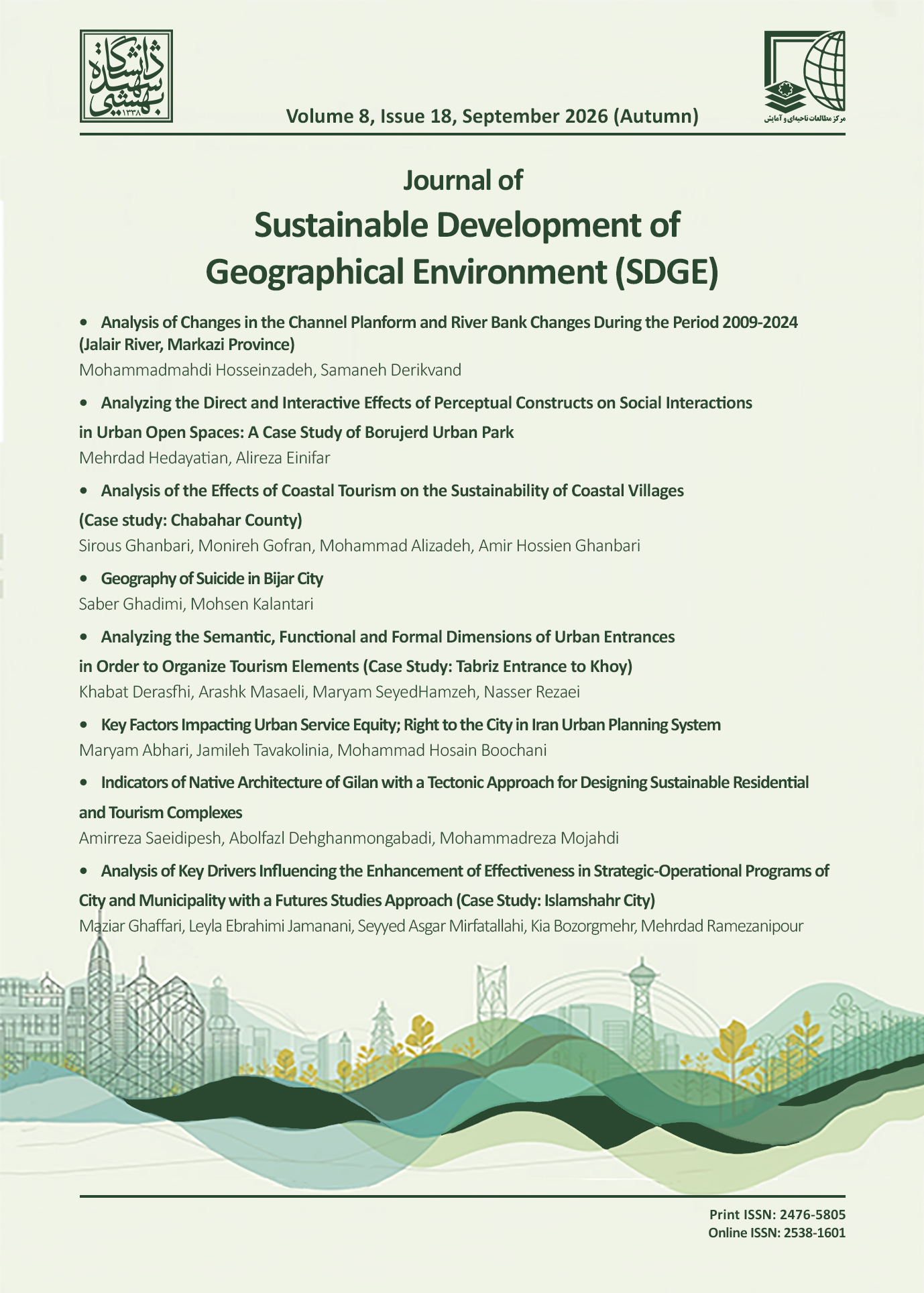
Current Issue: Volume 8, Issue 18, Summer 2026, Pages 1-148 (Autumn) 

Publication Information

Publisher

Director-in-Charge
Editor-in-Chief
Manager
International Editorial Board
Editorial Board
Executive Director
Page Designer
English Text Editor

Frequency
Quarterly
Print ISSN
Online ISSN

Indexing and Abstracting

Keywords Cloud

  • Sustainability
  • Sustainable development
  • Environment
  • Housing
  • Development
  • Tourism
  • Sustainable Urban Development
  • City
  • Tabriz
  • Tehran
  • Urban Development
  • Spatial analysis
  • Green space
  • Iran
  • Urban management
  • Futures Studies
  • Social interactions
  • Planning
  • Urban planning
  • Crisis Management
  • Resilience
  • participation
  • Grounded theory
  • Satisfaction
  • Ardabil
  • AHP
  • Inequality
  • Land use
  • Climate
  • content analysis
  • urbanization
  • social justice
  • urban livability
  • right to the city
  • Strategic planning
  • vulnerability
  • Culture
  • Meta-analysis
  • Public spaces
  • Karaj
  • Environmental sustainability
  • Morphology
  • Sustainable Rural Development
  • Decentralization
  • Presence
  • Lorestan province
  • Covid
  • Ranking
  • Structural empowerment
  • Zanjan City
  • \"
  • Urmia
  • Smart City
  • Policymaking
  • Strategy
  • Physical Factors
  • Structural Equations
  • urban resilience
  • Women
  • Spatial quality
  • Passive Defense
  • GIS
  • Maragheh City
  • migration
  • strategic plan
  • Sustainable employment
  • Key drivers
  • Citizen Satisfaction
  • livability
  • Governance
  • Agriculture
  • Air pollution
  • Factor analysis
  • Infrastructure
  • Rural settlements
  • Social Capital
  • Energy
  • Ilam
  • Green Building
  • Environmental hazards
  • Islamic city
  • Tabriz Metropolis
  • Feasibility
  • Bijar city
  • Region 4
  • Good Governance
  • Neighborhood
  • Spatial Justice
  • Urban environmental quality
  • sustainable income
  • Urban tourism
  • Zanjan Municipality
  • Behavior
  • Smart Growth
  • Quality of life
  • Geopolitics
  • Isfahan
  • Regionalism
  • Geo segregation Analyzer Software
  • townscape
  • Root yield
  • public participation
  • Ecosystem instability
  • Physical Identity
  • Varamin City
  • \' \' Supportive Action \'
  • Seismic vulnerability
  • Available resources
  • Regional Sustainable Development
  • Zabol
  • Kermanshah
  • social interaction
  • Human Development Index
  • regeneration
  • Wise City
  • Geopolitical Vertigo
  • Nightlife
  • Songhor city
  • Magnesium
  • Hesar Neighborhood
  • Mazandaran province
  • Saturation Moisture Content
  • Leveling
  • Medical Services
  • Metacomposition method
  • southern Iran
  • Tourism usage
  • ELECTRE Model
  • Ethnography
  • Hara
  • Valenjak neighborhood
  • Neighborhood\"
  • Court of Administrative Justice
  • flood and earthquake
  • Collaborative Governance Regime
  • Urban Sustainability
  • Nachi Catchment
  • happy city
  • Geotourism
  • Solar Power Plant
  • Physical Work Environment
  • District 10 of Tehran Municipality
  • Multi-Criteria Decision-Making (MCDM)
  • Psychological restoration
  • Sagharisazan
  • Border exchanges
  • Abbas Abad neighborhood
  • perception
  • Scenario Planning
  • Compact city
  • VOSviewer
  • critical
  • Habitat
  • \' \' Therapeutic Justice
  • urban regeneration Sustainable
  • Mehr housing cooperatives
  • Supervised classification
  • SEM
  • Multilevel Participation
  • Desert areas
  • Rural E-tourism
  • local government
  • TOPSIS ‎method
  • Villages in Sarband District
  • citizen participation
  • Nature tour
  • Cyborg Cities\"
  • tourism development
  • Epidemiology
  • Landscape components
  • Infill Development
  • NCT
  • Diplomacy
  • Rural areas of the west of Gilan
  • Hawraman
  • Morality
  • MAXQDA software
  • Local decentralization
  • environmental discourse
  • Human-Centeredness
  • Damghan
  • old neighborhoods
  • Security\"
  • Mehr housing
  • border function
  • Channel stability index
  • Quality of Living
  • White sugar
  • Arak City
  • Northwest Provinces
  • Manjil
  • Tehran metropolis
  • Historical Identity
  • Markov Chain and Cellular Automata Model (CA-Markov)
  • Least Mean Square Error Test
  • biodiversity
  • E-tourism
  • desire
  • El Goli and Baghmisheh parks
  • regenerative city